
Consumer beat · Cincinnati, Ohio
Shipley Do-Nuts Expands into Ohio with a Three-Unit Cincinnati Agreement
Shipley Do-Nuts signed a three-unit franchise agreement for Cincinnati, the brand's first move into Ohio, according to Food Service Equipment News. The agreement was tied to Koelache Co. LLC. It fits the chain's broader 2026 push into new U.S. markets.
The filing
The deal, as reported
Reported terms
- Franchise agreement
- Three units
- Territory
- Cincinnati
- Counterparty
- Koelache Co. LLC
- Reported by
- Food Service Equipment News
What the reporting names, and nothing beyond it. No development schedule or unit opening dates were disclosed in the coverage we read.
Why the number matters
Food Service Equipment News reported a three-unit franchise agreement covering Cincinnati, tied to Koelache Co. LLC. Three units is a modest number, which is exactly why it is informative. New markets usually open through franchise agreements where the operator carries much of the cost of land, buildout and staffing. The brand's own exposure stays limited while the operator's commitment does the signalling work.
That structure is why a small agreement still tells you something. An operator who puts money behind three sites in a market the chain has never traded in is betting on the brand's pull with local customers. The chain gets a read on demand in Ohio without funding the experiment alone.
It is also worth reading the agreement against the chain's public footprint. Shipleys donuts is a Texas-rooted name that has spent recent years filling in markets around its home base and along the southern corridor. Ohio is a different direction entirely, and the first of these units would sit well north of the chain's established trade area.
For readers in Cincinnati, the practical question is what a franchise agreement changes on the ground: very little at first. An agreement is a commitment to develop, not a set of addresses. Storefronts, hiring and opening dates follow later, and usually at the operator's pace.
Market entry
Why Ohio is a real test
Entering a new state is harder than adding stores near ones you already run. Dough for a morning donut case travels short distances well and long distances badly, so a new market means building a supply route, not extending an existing one. Staffing has to be recruited rather than shifted, and local awareness has to be earned from nothing.
Cincinnati is also a city with settled breakfast habits. The competition is not only other national donut chains but the neighborhood bakeries, coffee counters and grocery cases that already own the 6 a.m. customer. A brand arriving from Texas has to give those customers a reason to change a routine.
The other side of the ledger is position. Cincinnati sits within reach of other markets, so a small cluster here can serve as a base for a wider Midwestern push if the units perform. That is the case for treating three stores as a test line rather than a destination.
What a new state asks for
- A distribution route into the state, built and paid for rather than inherited.
- Store-level hiring in a labor market with no existing brand bench.
- Local awareness earned against bakeries and coffee counters already in the routine.
- A read on whether one successful cluster can support further Midwestern units.
What a franchise agreement actually buys
Three units, one operator, and a schedule nobody has published yet
A signed agreement sets a territory and a development obligation. It does not build a shop. Between the signature and an open door sit site selection, permitting, construction and hiring — the slow, unglamorous half of expansion that rarely makes the trade press.
The other side of the table
The franchisee side
Koelache Co. LLC is the counterparty named in the reporting. That is the whole of what the coverage establishes about the operator, and we are not going to dress it up with a company profile we cannot source.
Franchise agreements of this shape normally carry three things: a development schedule setting how many units open and by when, a defined territory the operator can build inside, and ongoing commitments on fees and standards. None of that detail is public here.
Development timelines are the easiest part of a franchise story to overstate, because an announced schedule is not a construction schedule. We report what was disclosed and leave the rest blank rather than filling it with inference.
How we read a deal like this
-
Disclosed
Unit count, territory and the named counterparty — the facts a press report can stand behind.
-
Inferred
Why a chain picks a market. Useful as analysis, but it is our reasoning, not the company's statement.
-
Unknown
Opening dates, site addresses and investment figures. Absent from the reporting, so absent here.
-
To watch
Whether the operator files for permits, signs a lease or announces a second agreement in the state.
That split is the method we apply across this beat, and it is why a small filing can carry a full page of reporting while a larger one sometimes cannot.
The wider push
An expansion strategy shows up as a series of small agreements, not one headline.
The Ohio deal belongs to a broader push into new U.S. markets, alongside trade reporting on the chain's retail presence. Reading the two together gives a better picture than either alone. Individually, each filing looks marginal: a few units, a single operator, a market nobody has heard the brand name in. Stacked over a year, the same filings describe a footprint moving outward.
Read the sequence
The Consumer page tracks each agreement and promotion in the chain's 2026 run as it is reported, so the pattern is visible in one place rather than scattered across trade coverage.
Read the Consumer sectionSame year, two jobs
The brand's other 2026 activity
Alongside expansion, the chain ran a 10-week 90th-anniversary promotion with rotating value offers, limited-time birthday donuts, a period of 90-cent glazed donuts, and another offering bonus loyalty points, as Community Impact reported. Growth and marketing are usually covered separately. Here they are two halves of the same year.
The promotion work matters to the expansion story for a plain reason. A discount campaign and a loyalty push train customers to visit on a schedule and hand the chain a list of people it can contact later. When a new market opens, that machine is what a franchisee is buying into.
Read the 90th-anniversary report
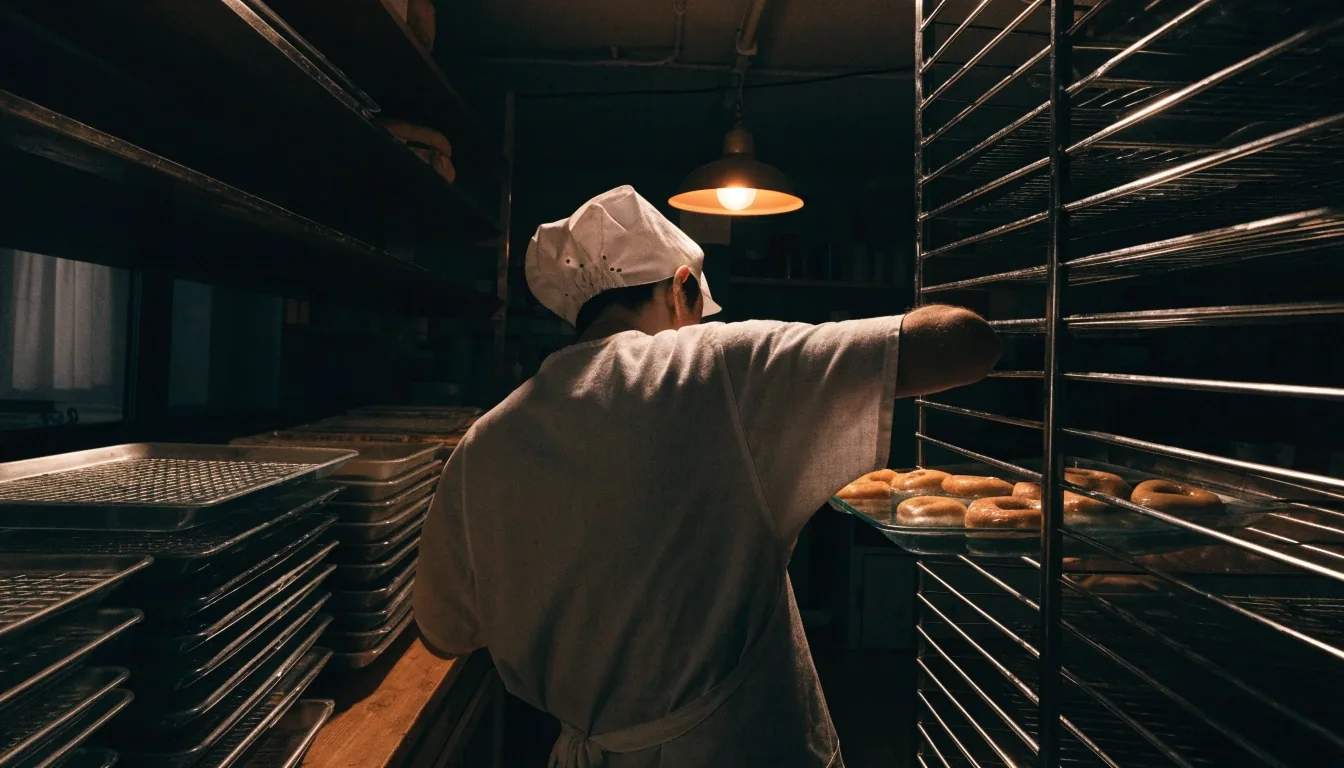
A doughnut counter after dark, the kind of storefront the Cincinnati agreement is meant to produce in a market that has not carried the name before.
Our watch list
What we will check next
Whether additional Ohio units are announced, whether the development schedule is disclosed, and whether the chain reports results from the market. Company statements get labeled as company statements, which is the rule we apply across this beat.
How we label sources in this beatWill the three Cincinnati units open at the same time? Open
Nothing in the reporting says so. Development agreements usually pace units so an operator can learn from the first before committing to the next, but the schedule for this one has not been published. We will report it when it is.
Does one agreement mean a statewide build-out? Open
No. Three units inside Cincinnati is a market test, and the territory in an agreement of this size is usually defined narrowly. Anything wider would have to be a new agreement with a new or expanding operator.
Where does the promotion news fit into this? Open
It sits on the other side of the same ledger. A 90th-anniversary campaign keeps existing customers close while franchise agreements carry the name into places it has never traded. Neither works as well without the other.
How should a reader weigh a three-unit filing? Open
As an early signal, not a result. It tells you where a chain intends to go and who is willing to fund the attempt. Sales, foot traffic and store survival in the market come later, if they come at all.
Next in this beat
Keep reading the Consumer beat
The Cincinnati agreement is one entry in a year of brand news. The Consumer page keeps the filings, promotions and retail reporting in sequence so the shape of the 2026 push is visible without chasing individual trade stories.
- Tips
- NicholasWillis@vinnykeates.com
- Phone
- +1 718 469 7363
- Desk hours
- Mon–Fri, 9:00 AM – 6:00 PM